Every Beach Near Bournemouth, Ranked and Reviewed
A local's guide to the beaches near Bournemouth, from the seven-mile Blue Flag stretch through to Sandbanks, Studland, and the Jurassic Coast, ranked for what you want.


On this page
Bournemouth is its beaches. Seven miles of golden, broadly Blue Flag-awarded sand stretching east from Branksome to Hengistbury Head, with another two hours of wilder Dorset coastline accessible by car or ferry. This is the most comprehensive coastline within an hour of London that does not require a car the moment you arrive, which is much of why the town exists as a holiday destination.
This guide walks every beach within a 30-minute drive of Bournemouth pier, with honest rankings for the things people actually need from a beach: families, dogs, surf, calm water, dunes, dramatic landscape, and the rare commodity of solitude.
A word on the rankings. We are not trying to crown a single best; we are matching beaches to intent. The right beach for a Tuesday morning swim is different from the right beach for a Saturday family picnic. The right beach with a dog in October is different from the right beach with a baby in July.
The Bournemouth strip, from west to east
The central seven miles is one continuous beach with named sections. Walking it end to end takes about three hours; doing it as a day with breaks is one of the best low-effort outings on the South Coast.
Branksome Chine (technically Poole)
The westernmost named section, sitting where Bournemouth meets Poole. Branksome Chine itself is a wooded ravine cutting down to the sand from the cliff-top, and the beach below is wider and quieter than the central Bournemouth sections. A handful of seafront cafés and the long-standing Branksome Beach restaurant give it an amenity edge over the more residential beaches.
Best for: families wanting a quieter base, sunset dinners, walking from a Westbourne stay.
Watch out for: parking on the cliff-top in summer; the beach itself is calm year-round.
Durley Chine and Middle Chine
The next two named sections moving east. Both are reached down wooded chines from the cliff-top, both have small seafront cafés, both are quieter than the pier zone. The water here is essentially the same Blue Flag-awarded stretch but you walk further to reach the supervised swimming zones.
Best for: a quieter section of the central beach, a long lunchtime walk from West Cliff.
Bournemouth West, Bournemouth Pier, Bournemouth East
The three central named sections, all directly below the Town Centre and the West Cliff. This is the busiest stretch of UK coast for much of July and August, with all the amenities (RNLI lifeguards in season, paid changing facilities, beach hut rentals, a continuous café row, the West Cliff and East Cliff lifts down from the cliff-top). The pier sits roughly in the middle.
Best for: first visits, anyone wanting the full seafront amenity experience, supervised swimming in the patrolled zone.
Watch out for: crowds in peak summer; sunbathers can be tightly packed. Dog access restricted May to September on this section.
Boscombe
The next major named beach east, centred on Boscombe Pier. Less crowded than the central section, a stronger surf and bodyboarding culture due to the artificial reef offshore, and a more eclectic seafront with independent cafés along the promenade. The Boscombe Chine cuts down from the cliff-top to the beach through gardens worth a separate visit.
Best for: surfers and bodyboarders, families with older children, anyone who wants the seafront amenities without the central crowds.
Watch out for: the surf reef is inconsistent; the wave it produces depends on tide and swell direction.
Southbourne and Fisherman's Walk
The next beach east, much calmer than Boscombe and a different demographic. Southbourne is residential, the beach is shelvier, the population is local rather than holiday-maker. The Fisherman's Walk section gets its name from a footpath up the cliff and remains one of the strongest family options.
Best for: families with young children, dog walkers outside summer restrictions, anyone staying east of the centre.
Watch out for: the beach is steeper here, the swim is colder; no pier or major amenity until you reach Hengistbury.
Hengistbury Head
The eastern end of the Bournemouth strip, and a complete change of character. The headland is a nature reserve, the beach at the base is wilder than anywhere else in the seven-mile stretch, and the Mudeford Spit at the eastern tip is the wildest accessible beach in the immediate area. Reached by walking from the visitor centre (about 25 minutes) or by the land train (seasonal).
Best for: walkers, photographers, anyone who wants the Bournemouth beach experience without the resort crowd.
Watch out for: limited amenity, no supervised swimming, the wind can be sharp at the headland.
We walked from Boscombe to Hengistbury and back over a day, and I cannot believe how much beach you get without paying anything for it. In Germany this would be the most expensive coastline in the country.
A first-time visitor from Berlin, August 2025
Past the borders: Sandbanks, Studland, and the Purbeck coast
The beaches west of Bournemouth, technically in Poole and Dorset, are some of the most photographed in the UK.
Sandbanks
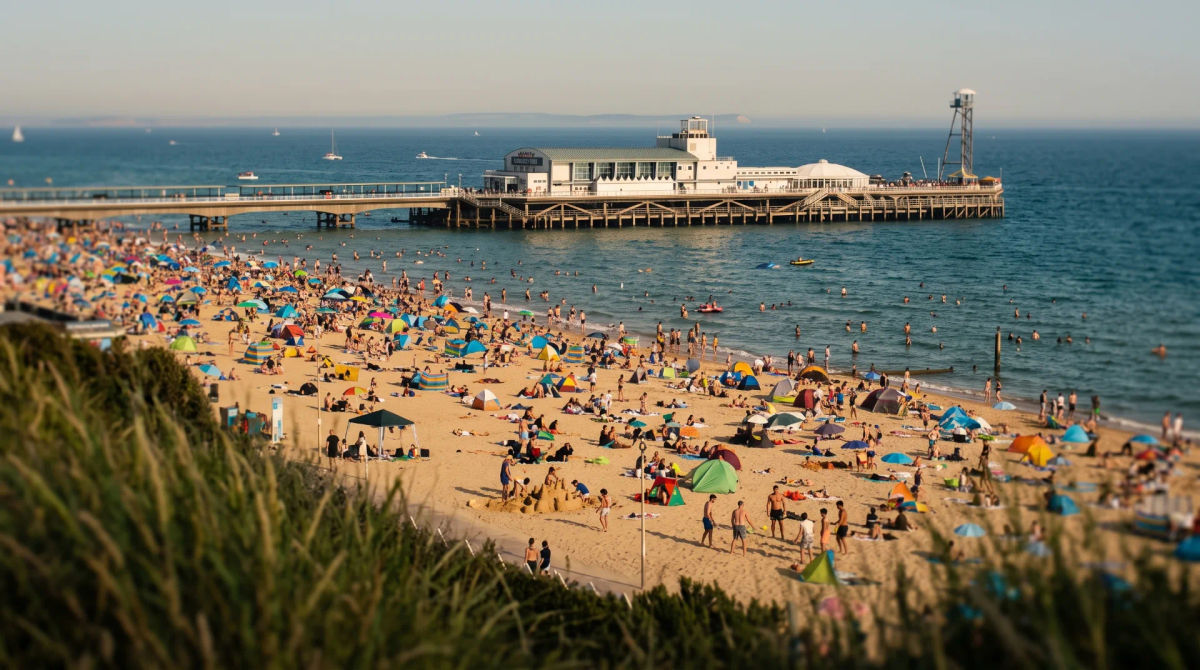
The expensive end of the British coast. Sandbanks Beach is wide, white, and reliably uncrowded outside summer weekends because the peninsula's residential density is low and the beach is large. The Sandbanks Chain Ferry connects the tip to Studland, and the Brownsea Island ferry runs from the harbour side.
Best for: a quieter and wider beach than central Bournemouth, the gateway to Studland and the Purbeck coast, sailing.
Watch out for: parking is expensive and limited; in peak summer the only practical access is the bus or the ferry from Poole Quay.
Knoll Beach, Middle Beach, Shell Bay (Studland)
Across the Sandbanks Chain Ferry, the Studland peninsula has four distinct beach sections backed by sand dunes and managed by the National Trust. Knoll Beach is the busiest with the most amenity, Middle Beach is between the two villages, South Beach has the small village and the Bankes Arms pub, and Shell Bay at the northern tip is the most secluded and the closest to the ferry.
Studland is also the access point for Old Harry Rocks, the chalk stacks at the eastern end of the Jurassic Coast. Walking from Knoll Beach to Old Harry Rocks takes about 45 minutes one way along the cliff-top.
Best for: families, walkers, sandcastle building (the sand here is unusually clean and fine), the Old Harry Rocks day trip.
Watch out for: South Beach is a designated naturist beach for part of its length, clearly signed but worth knowing in advance.
Swanage
Past Studland, a 35-minute drive from Bournemouth, sits Swanage and its own bay. The beach is sheltered, the town is the only one on the Purbeck coast, and the steam railway and the Pier add the day-out factor.
Best for: a full day out with a town meal, families wanting a clear "destination" rather than a sand strip, train enthusiasts.
Lulworth Cove and Durdle Door
The farthest of the regular day-trip beaches, about 50 minutes by car from Bournemouth. Lulworth Cove is the geological draw, almost a perfect horseshoe carved into the Jurassic Coast. Durdle Door is the natural arch a 15-minute walk west, requiring a steep path down from the clifftop car park.
Best for: photographs, geology, the famous Durdle Door arch, but be prepared for crowds in peak summer.
Watch out for: the path down to Durdle Door is steep; the cove itself can fill the car park early on summer weekends. Arrive before 10:00 or after 16:00 in season.
Mudeford Spit (east of Bournemouth)
The narrow sand spit projecting into Christchurch Harbour, with privately-owned beach huts on one side and the open sea on the other. Reached by walking from Mudeford Quay (about 25 minutes) or by the small Mudeford Ferry. The Beach Hut Café on the spit is one of the better seafood lunches in the area.
Best for: a different beach experience, families with older children, anyone who has done the central beaches and wants somewhere new.
Watch out for: the spit floods on very high tides and during storms; check the tide table before walking out.
Avon Beach (Mudeford to Christchurch)
A small stretch between Mudeford Quay and the harbour, mostly local, with the Mudeford fishing fleet visible. Not a destination beach; useful if you are doing Christchurch and Mudeford as a day trip and need a beach interlude.
Ranked, by what you want
Best for families
- Southbourne: calm, residential, easy parking
- Branksome Chine: wider beach, fewer crowds
- Studland Knoll Beach: clean sand, dunes, National Trust amenities
- Boscombe: surf for older children, beach huts, the pier
Best for solitude
- Hengistbury Head and Mudeford Spit: the wild eastern edge
- Shell Bay (Studland): the most secluded of the dune beaches
- Studland Middle Beach: between the two villages
- Bournemouth West in winter: empty between October and Easter
Best for surf
- Boscombe: the only surf-led beach with consistent lessons
- Branksome and Sandbanks for paddleboarding rather than surf
- Studland Knoll Beach for windsurfing
Best for dogs
- Sandbanks and Branksome: year-round dog access
- Hengistbury Head: year-round subject to nesting bird seasons
- Bournemouth East and West: outside summer (October to April)
- Studland: year-round (subject to National Trust nesting closures)
Best for sunset
- Branksome Chine: west-facing, less crowded
- Bournemouth West Cliff promenade: elevated view across the bay
- Sandbanks: west-facing, sea on three sides
- Studland Shell Bay: west-facing, looking back to Sandbanks
Best for walking
- Hengistbury Head to Bournemouth Pier: a full afternoon
- The South West Coast Path from Bournemouth to Branksome: cliff-top
- Knoll Beach to Old Harry Rocks: 45 minutes one way, the great Dorset cliff walk
- Bournemouth Pier to Boscombe Pier and back: flat promenade, 90 minutes round trip
Best for swimming
- Bournemouth Pier supervised zone: RNLI, calm, family-tested
- Studland Knoll Beach: supervised, fine sand bottom
- Branksome Chine: supervised, wider beach, less crowded
- Sandbanks: supervised, sheltered by the peninsula
Practical notes
Lifeguards patrol the central Bournemouth beaches from late May to late September. Always swim between the red-and-yellow flags. The further beaches towards Hengistbury Head and Shell Bay are not supervised.
Beach huts rent across the seven miles, with the highest concentration at Boscombe, Branksome, and Mudeford. Day rentals are usually available in shoulder season; in peak summer most huts go weekly or seasonally. Mudeford Spit huts are private and not for daily rental.
Parking is the single biggest constraint in peak summer. The central beach car parks fill by 09:00 on July and August weekends. Branksome, Sandbanks, and Studland are even worse. Use the buses, the seasonal beach trains, or arrive before 09:00.
Tide times matter most at Hengistbury Head and Mudeford Spit, where the spit can flood at very high tides, and at Studland, where the swim distance to the sea is much longer at low tide.
Water temperature ranges from about 8°C in February to about 19°C in August. The water remains swimmable for hardier visitors through October.
For a base within walking or short bus distance of most of these beaches, book direct with Flexiestays for around 15% less than the major booking platforms charge. Most of our buildings are within a 12-minute walk of Bournemouth pier, which puts you 15 to 30 minutes from the rest of the beaches in this guide.
Frequently asked questions
Bournemouth's coastal stretch holds several Blue Flag beaches across the seven-mile span, with the central beaches awarded annually. Branksome Chine, Bournemouth East, Bournemouth Pier, Bournemouth West, and Durley Chine have been Blue Flag recipients in recent years. Awards are reissued each year by Keep Britain Tidy, so the current list is worth checking on the council page before a trip.
Southbourne and Branksome are the strongest family beaches. Both have calmer water than the central pier section, easier parking nearby, less density of holidaymakers, and accessible toilets and cafés within a short walk. Bournemouth Central works for families too if you stay close to the pier supervised area, but expect crowds in peak summer.
Dog access on the central Bournemouth beaches is restricted in summer (typically May to September). Outside those months, the entire seven miles is dog-friendly, including the promenade. Branksome and Sandbanks have year-round dog zones, and Hengistbury Head allows dogs throughout the reserve subject to ground-nesting bird seasons in spring. The council page has the authoritative seasonal map.
Boscombe is the surfing centre, with an artificial reef offshore and several surf schools running lessons in summer. The waves are modest by Cornish or Welsh standards; this is a beginner-friendly coast rather than an experienced-surfer destination. The reef has had a complicated history and the wave it produces is inconsistent, but the lessons run regardless. Branksome and Sandbanks are quieter alternatives for paddleboarding and kayaking.
By car, it is a 20 to 30 minute drive depending on traffic, parking on the peninsula in summer is hard and expensive. By bus, the route 50 from Bournemouth Square runs roughly hourly and takes about 50 minutes. By foot, the South West Coast Path along the cliff-top takes around two hours including a coffee stop. The Sandbanks Chain Ferry connects the peninsula to Studland and the Purbeck coast.
Hengistbury Head and Mudeford Spit, at the eastern edge of Bournemouth, are the wildest accessible beaches in the immediate area. The headland is a nature reserve with restricted vehicle access and the spit is reached by a 25-minute walk or a small ferry from Mudeford Quay. For something even quieter, Studland's Shell Bay (just past the ferry) is the most secluded of the dune beaches.
The central beaches at Bournemouth, Boscombe, and Southbourne are supervised by RNLI lifeguards in season (typically late May to late September) with red-and-yellow flags marking the safe swimming zones. Branksome and Sandbanks have seasonal lifeguard cover. Studland's Knoll Beach is supervised; the further beaches towards Shell Bay are not. Always check the flag colours and avoid swimming outside the patrolled zones.