
Surfing in Bournemouth: A Beginner's Guide
A practical guide to learning to surf in Bournemouth, with the surf reef, beach options, lesson providers, season notes, and an honest read on what the waves are like.


On this page
This guide is for the visitor who has heard that Bournemouth has surf and wants to know whether it is worth a lesson or a board hire. The honest version is that Bournemouth is a beginner-friendly learner coast rather than a destination for experienced surfers. That framing matters because expectations matter.
If you have never surfed and you want to try it in a forgiving environment, with warm-water summers and consistent (if modest) lessons, Bournemouth is excellent. If you already surf at intermediate level or above and are looking for shape and size, you are in the wrong county; head to Cornwall or Devon.
Why the waves are what they are
Bournemouth sits on the eastern end of Poole Bay, which faces south into the English Channel. The Channel is sheltered relative to the open Atlantic, so swell here is smaller and more inconsistent than the north-facing UK coasts. The seabed shelves gently rather than steeply, which produces broken white-water waves close to shore (perfect for beginners) but rarely the clean shoulder a more advanced surfer would want.
What this means in practice:
- Wave size: typically 1 to 3 feet, occasionally up to 4 to 5 feet in autumn storms
- Consistency: variable; September to November is the strongest run; mid-summer can be flat for weeks at a time
- Sea state: cleanest with offshore winds (northerly), choppy with onshore (southerly)
- Crowds: light by Cornwall standards; busiest at Boscombe in summer
The Boscombe artificial reef
The most-asked question about surfing in Bournemouth is whether the reef "works". An artificial underwater reef was installed about 220 metres offshore from Boscombe Pier in 2009, with the design intent of amplifying wave size and creating a more consistent surf break.
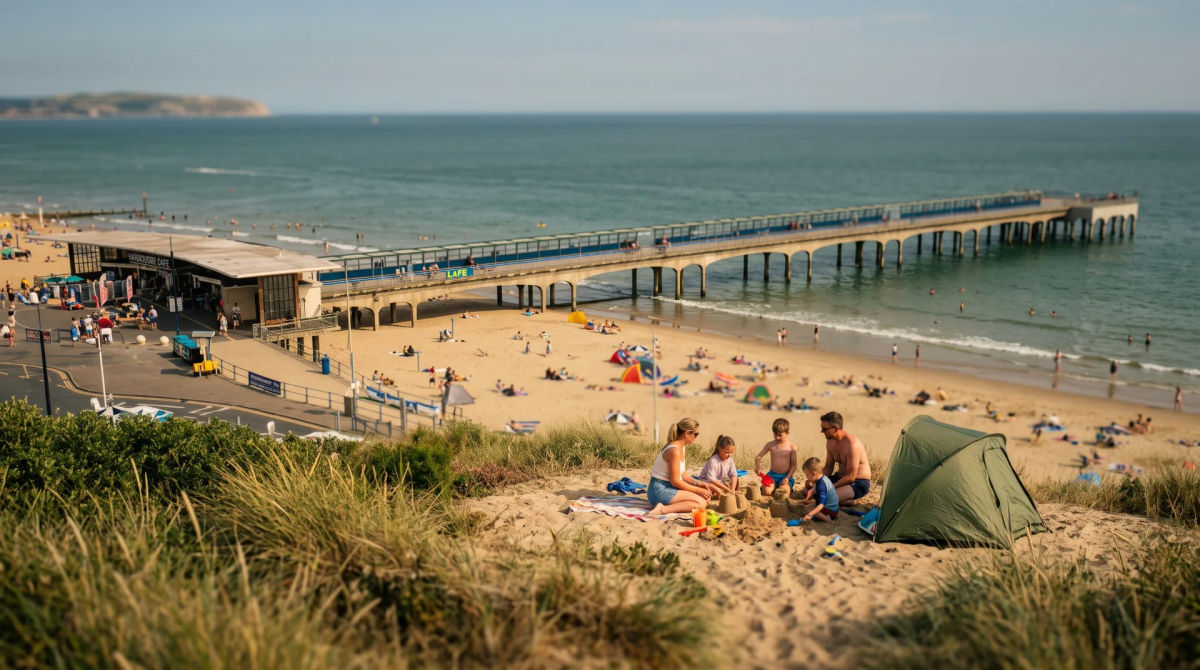
The project has had a complicated history. Structural issues required closures and partial rebuild, and the wave the reef produces has been variable in practice. Local surfers are split between cautiously positive and dismissive views.
For a beginner taking a lesson, the reef is largely beside the point. The lessons happen in the white-water zone between the beach and the reef, where the natural beach break works fine. The reef question matters more for intermediate surfers hoping for a peak that is not always there.
Where to go
Boscombe Beach is the surfing centre of Bournemouth. The pier and the reef are the focal point, the surf schools run from here, and the surf shops and hire outlets cluster on the seafront. If you take a lesson, you will almost certainly be at Boscombe.
Bournemouth central beach (around the pier) gets some surf in larger conditions but lacks the surf infrastructure of Boscombe. Generally avoid the supervised swimming zone with a board in season.
Southbourne and Hengistbury Head sometimes pick up surf at higher tides and in storm conditions, but they are not lesson destinations.
Branksome and Sandbanks are quieter and better suited to paddleboarding and kayaking than surfing.
For a fuller view of how the beaches compare beyond surf, the every beach guide walks through the seven miles east to west.
Taking a lesson
The standard route in is a two-hour group lesson with a local surf school. Boscombe has several long-established providers operating from the seafront. A typical lesson:
- Beach briefing (15 to 20 minutes): equipment, safety, the basics of paddling and pop-up technique
- In the water (90 minutes): white-water sessions, with the instructor in the water alongside, helping you catch waves and stand up
- Cool-down on the beach: review, photographs if you bought the package
Prices vary by season and school but expect £30 to £45 per person for a group lesson, all kit included. One-to-one lessons run higher (£60 to £90). Family packages are common.
Most schools accept children from around age 8, subject to swimming confidence. Wetsuits are provided across all sizes.
What to bring: swimwear under the wetsuit, a towel, sun protection (the sea reflects strongly), water, a snack. Cars on the seafront can be locked and visible from the surf zone.
Independent surfing
If you can already surf and want to hire kit, several Boscombe outlets do board and wetsuit hire by the session or day. Typical rates:
- Soft-top beginner board + wetsuit: £15 to £25 per session
- Performance board + wetsuit: £25 to £40 per session
- Daily hire: discount on the session rate
Surf shops in Boscombe also sell beginner boards and wetsuits if you are serious enough to want your own kit. Magic Seaweed and Surfline both cover Boscombe in their forecast data; check before travelling.
Other water sports
Surf is far from the only thing you can do on a Bournemouth beach. The town is a strong stand-up paddleboard (SUP) destination, with calmer water on the central beaches making it easier than surf for first-timers. Kayak hire runs from Boscombe and Sandbanks. Kitesurfing is occasional at Sandbanks; check local conditions.
For a quieter water experience, Sandbanks and Studland (across the chain ferry) are the standard answer. The Sandbanks side is sheltered by the Poole Harbour entrance; the Studland side is more exposed.
Season notes
Spring (March to May): water is cold but warming, fewer crowds, modest waves. Wear a thicker wetsuit.
Summer (June to August): warmest water of the year (often 18 to 20 degrees), small waves, busy beaches, lots of beginner lessons. Best for a first try if you want comfort.
Autumn (September to November): the surf season. Bigger swell, water still warm into October, lighter crowds than summer, the most consistent waves of the year.
Winter (December to February): biggest swell of the year, coldest water (8 to 10 degrees), wind and rain. Reserved for the committed local crew.
For practical events around the local surf scene, the Boscombe Surf Festival runs weekend taster sessions in summer, free to attend.
For a base within walking distance of Boscombe surf, our neighbourhoods guide covers Boscombe in detail. Aparthotels in Boscombe put you steps from the seafront and the pier where the lessons launch.
Book direct with Flexiestays for around 15% less than the booking platforms charge. Several of our buildings sit close to the Boscombe seafront, putting you within easy reach of a morning lesson and a coffee afterwards.
Frequently asked questions
Yes, but with the caveat that the waves here are modest compared to Cornwall, Devon, or the north Atlantic coasts. Bournemouth is best understood as a beginner-friendly learner coast, not a destination for experienced surfers chasing big swell. The artificial reef offshore at Boscombe adds occasional more shaped waves but its consistency has been debated locally.
September to November is the strongest season for swell. The water is still warm from the summer (around 16 to 18 degrees in early autumn) and storm fronts produce more consistent waves. Spring and summer have smaller waves but warmer water; winter brings the biggest swell but the cold and the wind.
The Bournemouth Surfing Centre on Boscombe seafront is the longest-established provider, running group and one-to-one lessons in season. Several other smaller operators run beach-front lessons in summer. Expect to pay around £30 to £45 for a two-hour group lesson including board and wetsuit hire.
No, surf schools include both in the lesson price. If you are surfing independently, board and wetsuit hire is available from multiple Boscombe seafront outlets in summer, typically £15 to £25 per session. Buying a beginner's board makes sense only if you plan to surf regularly through the season.
Yes, with the usual sea safety caveats. The seafront is supervised by RNLI lifeguards in season (late May to late September) with red-and-yellow flags marking safe swimming and surfing zones. Surf schools accept children typically from age 8 upwards. Bring sun protection; the sea reflects strongly.
An artificial underwater reef was installed off Boscombe Pier in 2009 to amplify wave size and consistency. It has had a complicated history, with structural issues and questions about how reliably it produces the waves it was designed to. Local opinion ranges from cautiously positive to dismissive. The lessons run regardless because the natural beach break works for beginners.


